- Vineyard
- Winemaking process
- Harvest
- Production
- Inventory
- Procurement
- Documents
- Sales and hospitality
- E-invoicing
- Cost of production
- Banking
- Imports
- Reports
- Administration
- Upcoming
Status labels: Available is in Release 1, November 2026. 2027 · S1 is planned for the first half of 2027, 2027 · S2 for the second half. Upcoming is in the backlog, not yet dated.
Vineyard Available
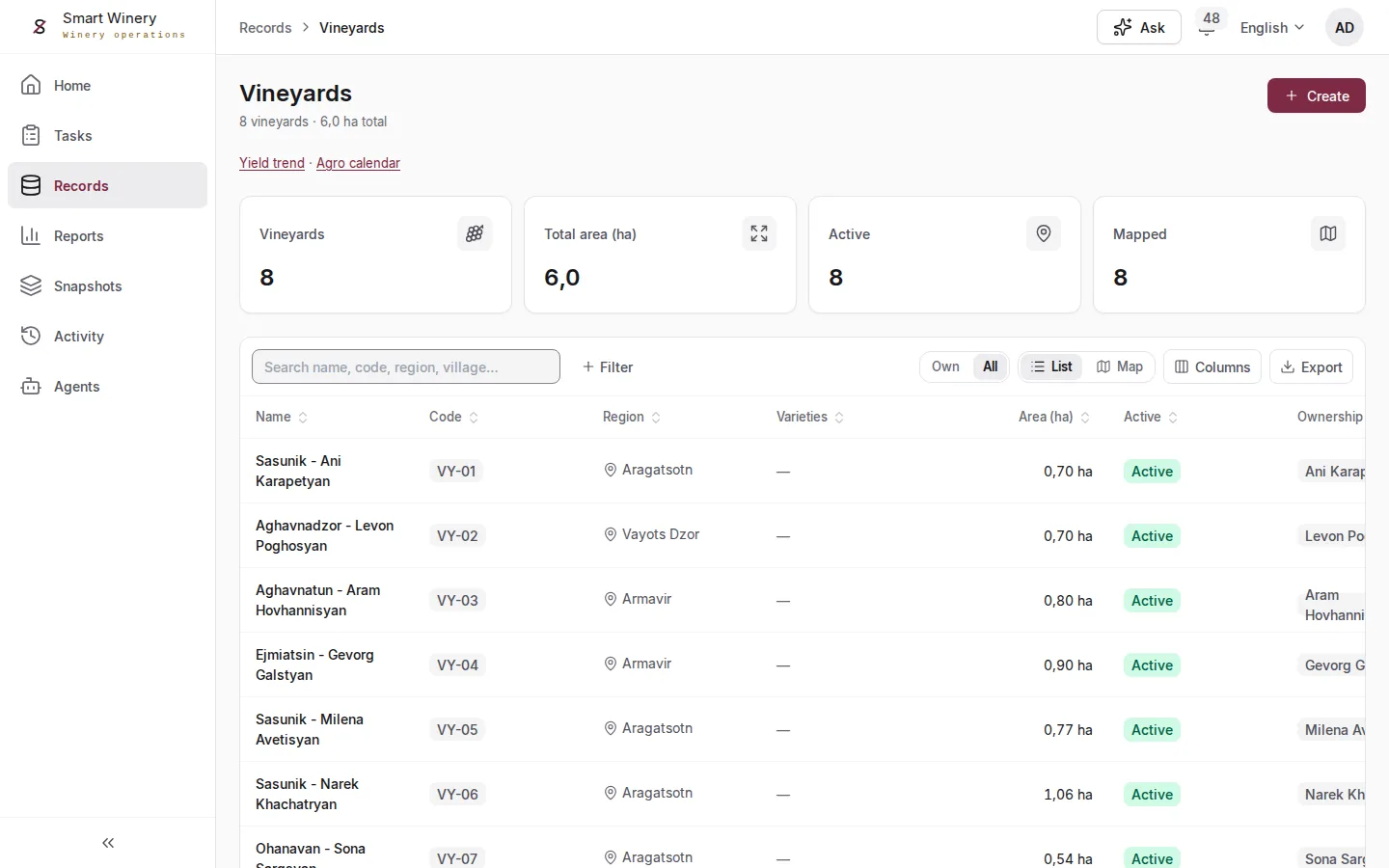
Every vineyard and block with its area, varieties and full season of work.
- Define the vineyard. Region and village, own or contracted from a grower, altitude, soil, orientation and terroir notes. Draw the vineyard and its blocks on a map; the area in hectares is calculated from the drawing, and the map colours each block by variety.
- Varieties. Each block carries its varieties and planting year, chosen from a grape catalogue that understands synonyms.
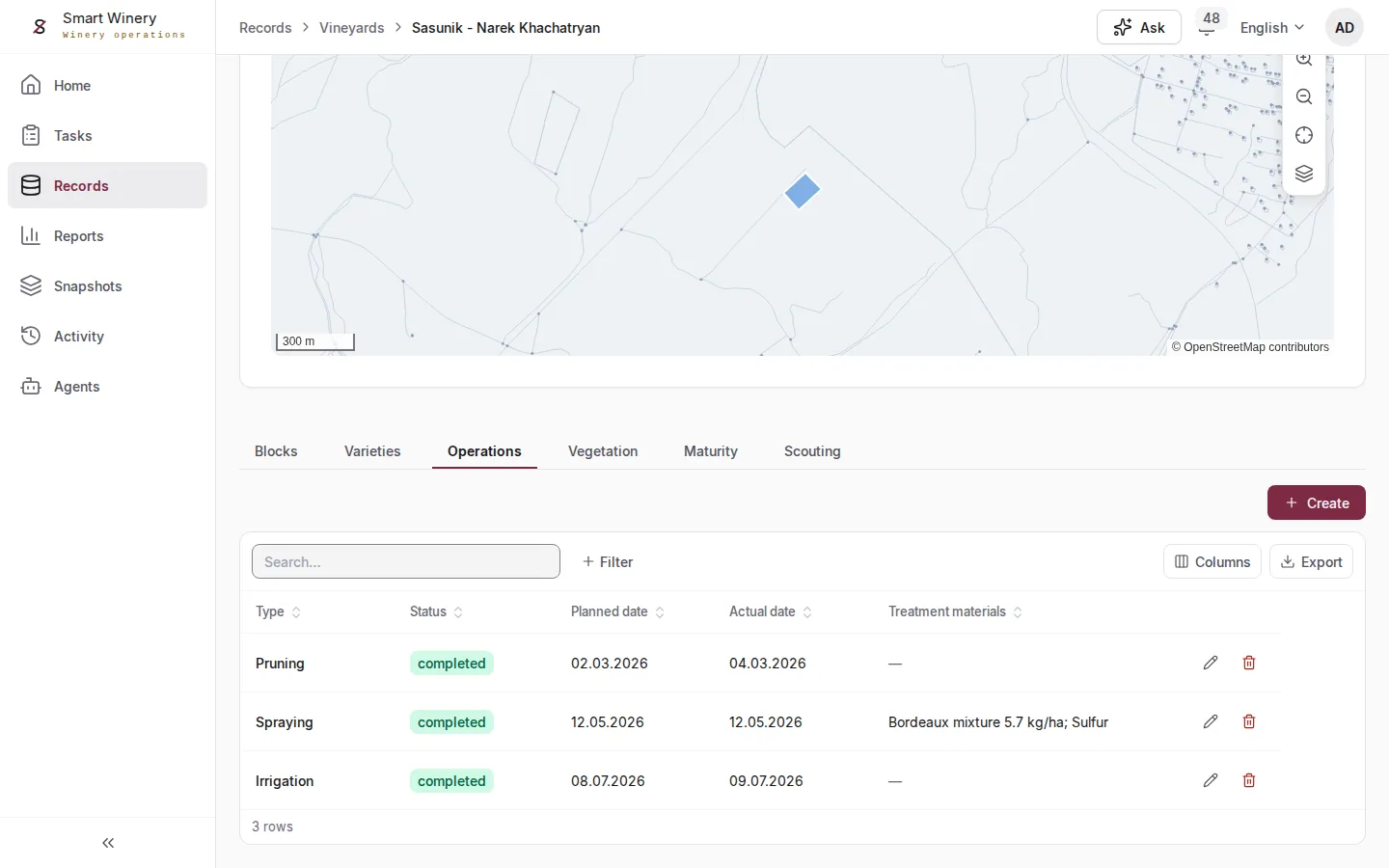
- Operations. Tillage, irrigation, spraying, canopy work and harvest, planned or done, with the area treated, who did it and the cost. A spray can list several products with a dose per hectare. The agro-operations calendar downloads as Excel.
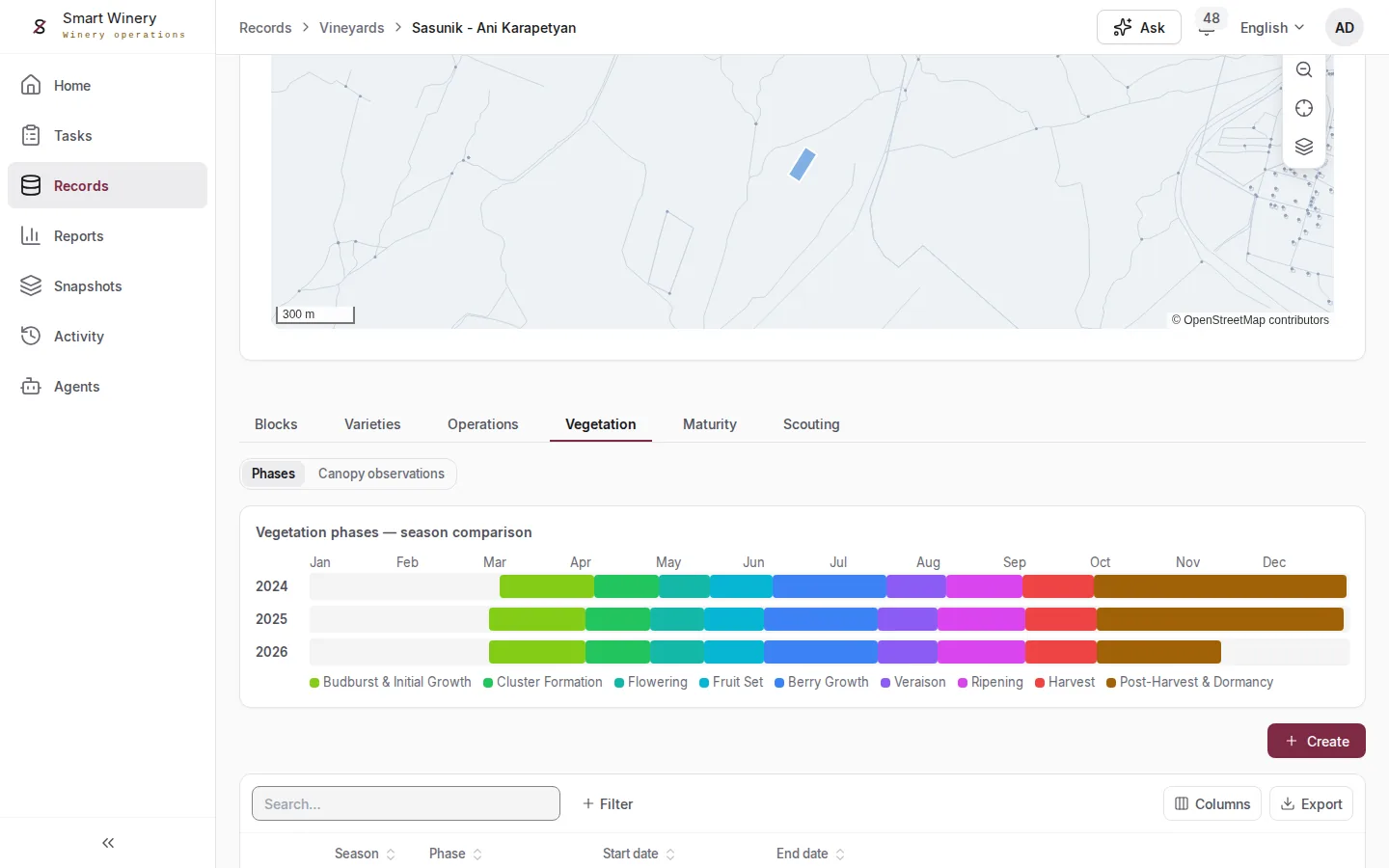
- Vegetation tracking. Nine colour-coded growth stages, from budburst to dormancy. A chart puts the last three seasons on their own lanes on the same January to December axis, so this year is compared with past years at a glance.
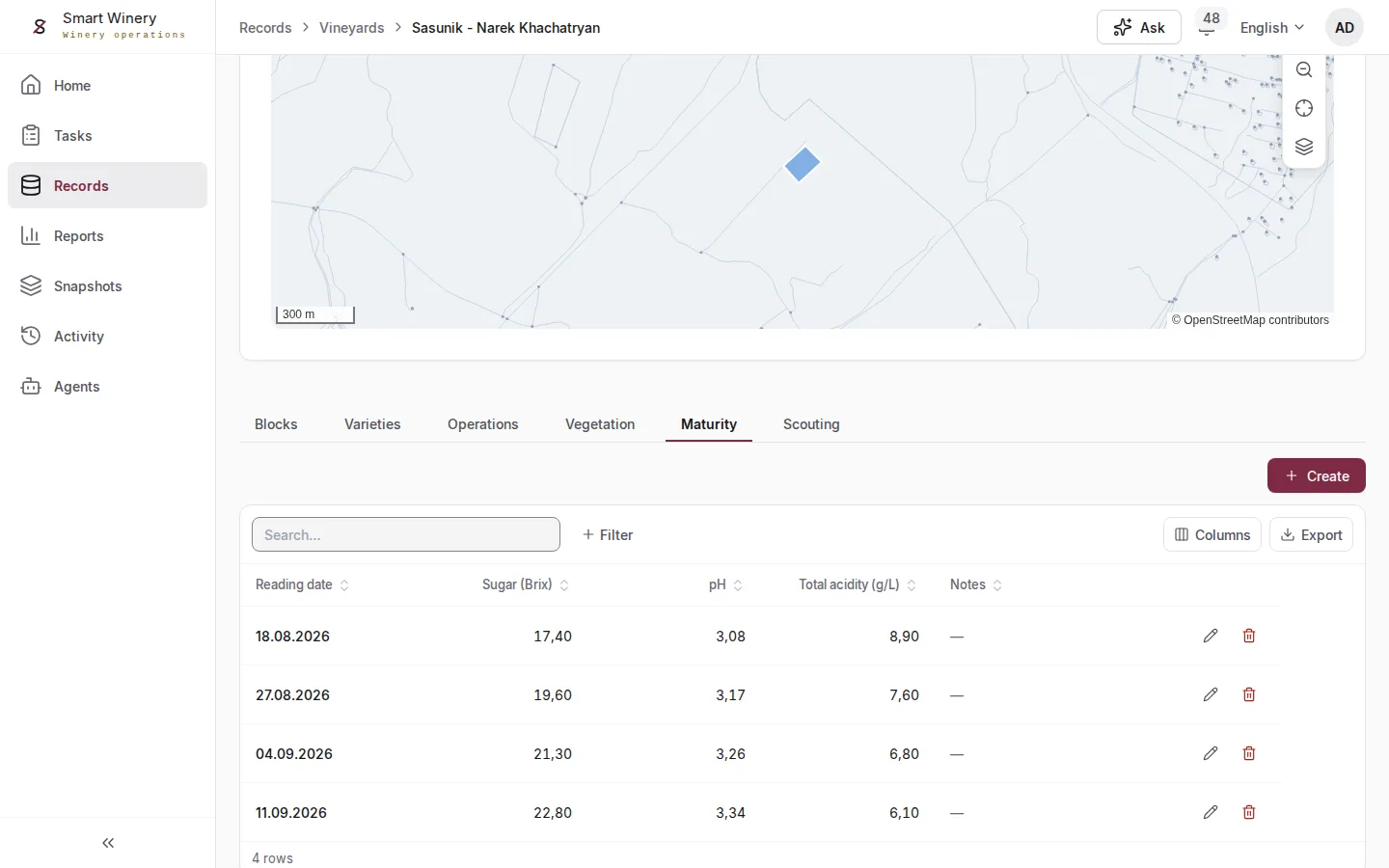
- Maturity. Samples with Brix, pH and total acidity per block.
- Scouting. Pest or disease, severity from 1 to 5, affected area, GPS position and the recommended treatment. A severe finding raises an alert.
Winemaking process Available
Write down how the winery makes each style of wine, then follow it for every batch.
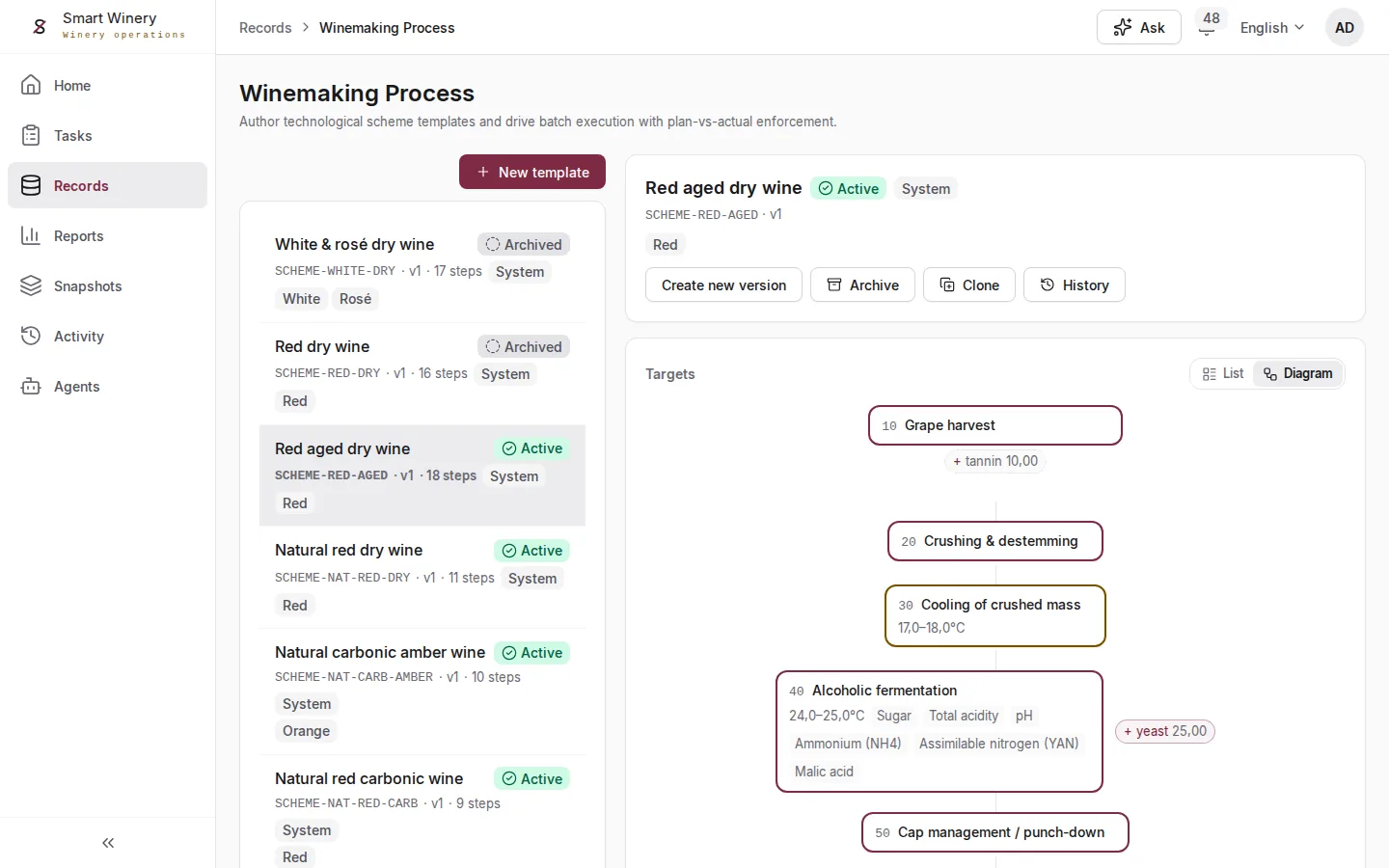
- A process per style. One template for each wine type, drawn as a diagram, with versions. Running batches keep the version they started with.
- Steps. Required or optional, in order or in parallel, with a target temperature, a planned duration, additions with doses, and lab checks before a step starts or ends that warn or block.
- Reminders. Repeating steps such as topping, with their own schedule. Overdue steps and topping due raise alerts.
- Follow it. Start, complete or skip a step with a reason, add an unplanned step, or turn a step into a cellar work order. A printable run record per batch.
- Deviations. A skipped or changed step is recorded as a deviation with its reason; where the winery’s rules require it, it goes to an approver.
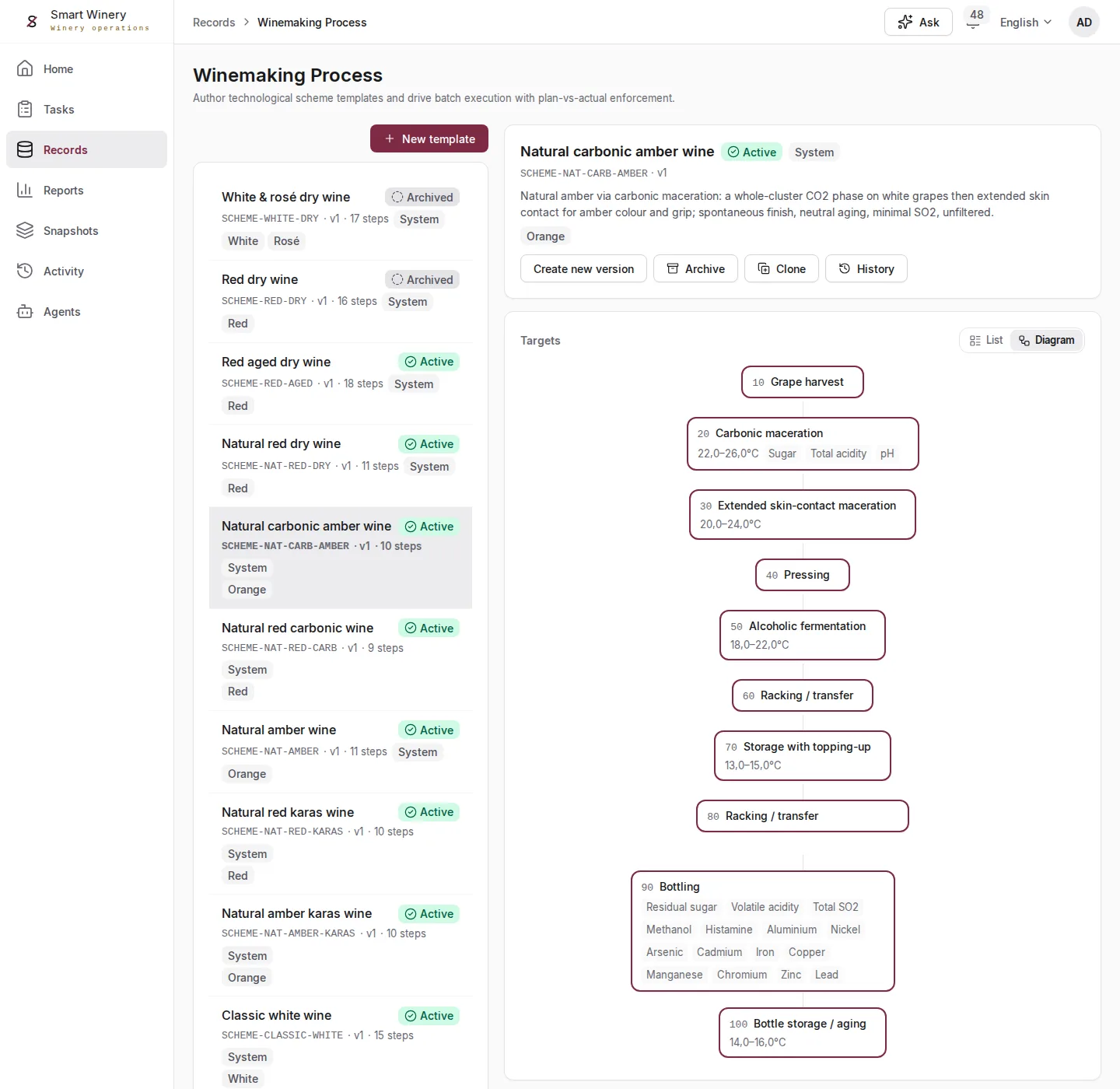
Example: natural amber wine, carbonic maceration, aged in karas
A template the winery could write once for this style. Every batch of it then follows the same steps, with the same checks and reminders. The numbers are the winery’s own settings, shown here only as an example.
-
Harvest and reception
Hand-picked whole clusters of white grapes, weighed by box. A check on Brix and on intact bunches before the grapes are accepted.
- Brix 20–23
- Check: warns outside range
-
Carbonic maceration
Whole clusters sealed under a CO₂ blanket, uncrushed. The fermentation starts inside the berries. Daily temperature reading.
- 8–12 days
- Target 20–28 °C
- Repeats daily
-
Into the karas, skin-contact fermentation
Clusters crushed and moved, with skins, into buried clay karases. Native yeast only, no additions. Brix and temperature logged each day.
- 2–4 weeks
- At most 24 °C
- Additions: none
-
Fermentation finished
A lab check closes the step: residual sugar and volatile acidity. A high volatile acidity stops the batch from moving on until the winemaker looks at it.
- Sugar below 2 g/L
- Volatile acidity: blocks if too high
-
Sealed on the skins
The karas is closed and the wine stays on its skins to take its amber colour and structure.
- 3–6 months
-
Off the skins
The wine is racked to a clean karas, and the skins are pressed. Volume and loss are recorded, so the trace back to the grapes stays complete.
- Transfer with loss
-
Ageing in karas
Topping as a repeating step: a reminder every two weeks, less often after the first year. Topping that is due or overdue raises an alert.
- 12–18 months
- Topping every 2 weeks
- Monthly after year 1
-
Ready for bottling
A final lab check on stability and volatile acidity, then bottling unfined and unfiltered.
- Lab check before bottling
- No fining, no filtering
If someone adds sulphur or skips a step, the change is recorded as a deviation with its reason. The template can send it to the winemaker for approval, so a natural wine stays natural by rule, not by memory.
Harvest Available
Record the picking, then weigh every delivery in.
- Harvest records. Vineyard, variety, hand or machine picking, planned and actual dates, kilos, Brix, acidity, pH, quality grade and pickers. A board shows each harvest’s status.
- Grape reception. Weigh by box (box type, count, gross weight, tare per box, net weight calculated) or by weighbridge ticket. Record Brix, acidity, pH, temperature, price per kilo and total cost.
- Traceable from the start. Each reception is tied to its vineyard or grower.
Production Available
The cellar’s daily work, recorded once and traceable forever.
- Overview. Active and fermenting batches, vessels in use, a board from reception to bottling, an attention list of fermentations that need a look, and a vintage comparison of stage durations and chemistry across years.
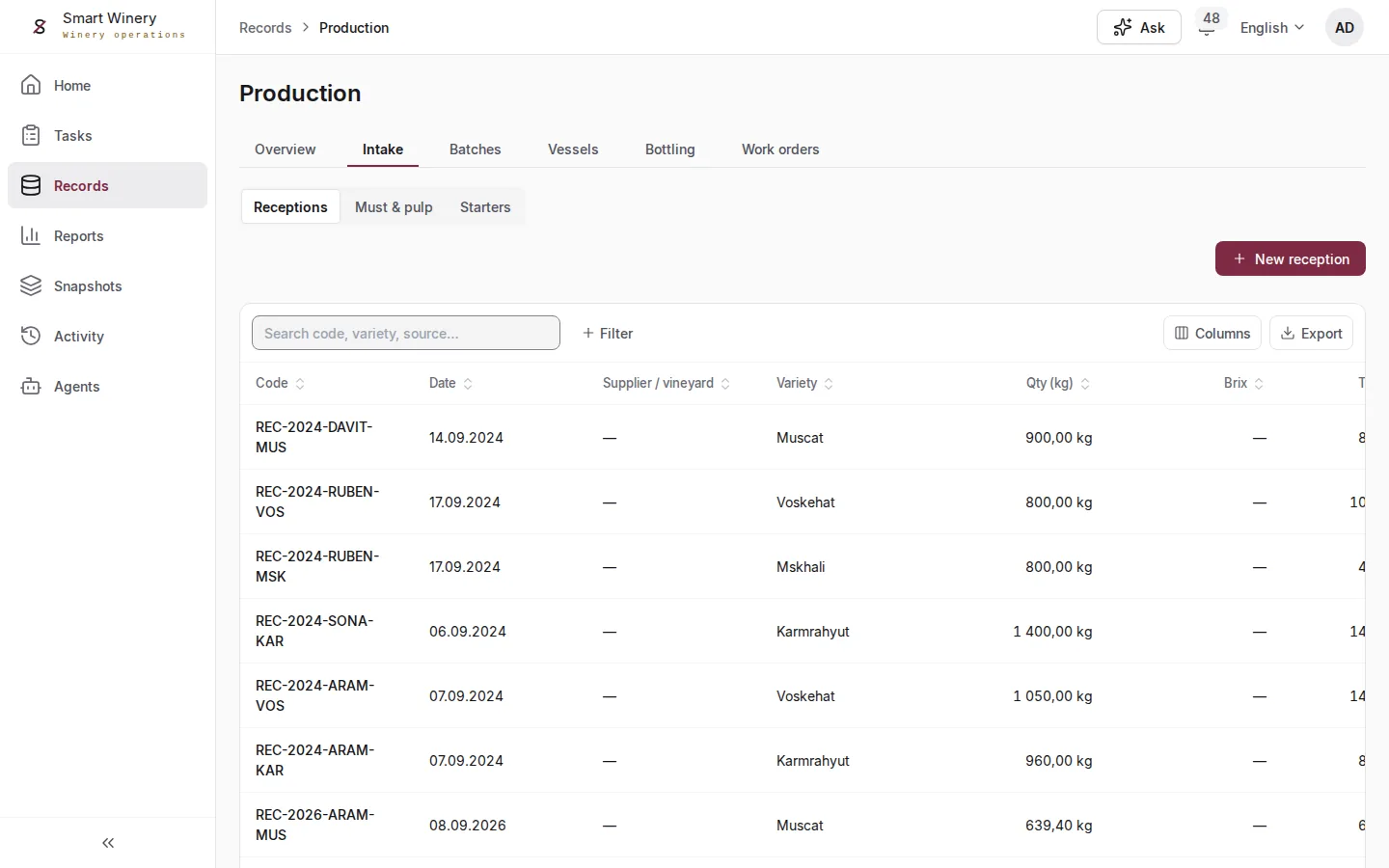
- Intake. Receptions, must and pulp with clarification, yeast strains, starters and inoculation.
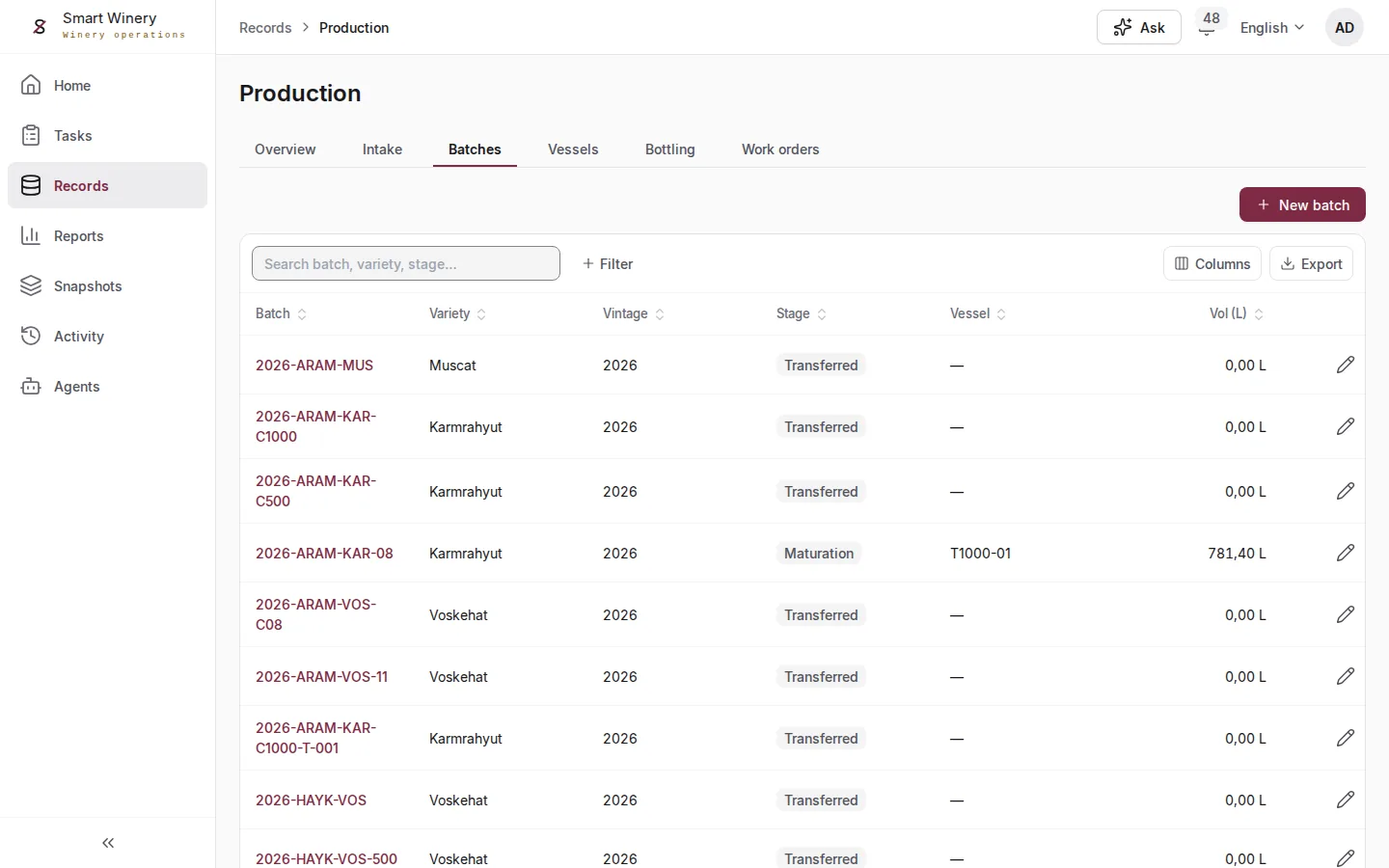
- Batches. Additions, transfers between vessels with expected loss, maturation, stability checks and a full trace back to the grapes.
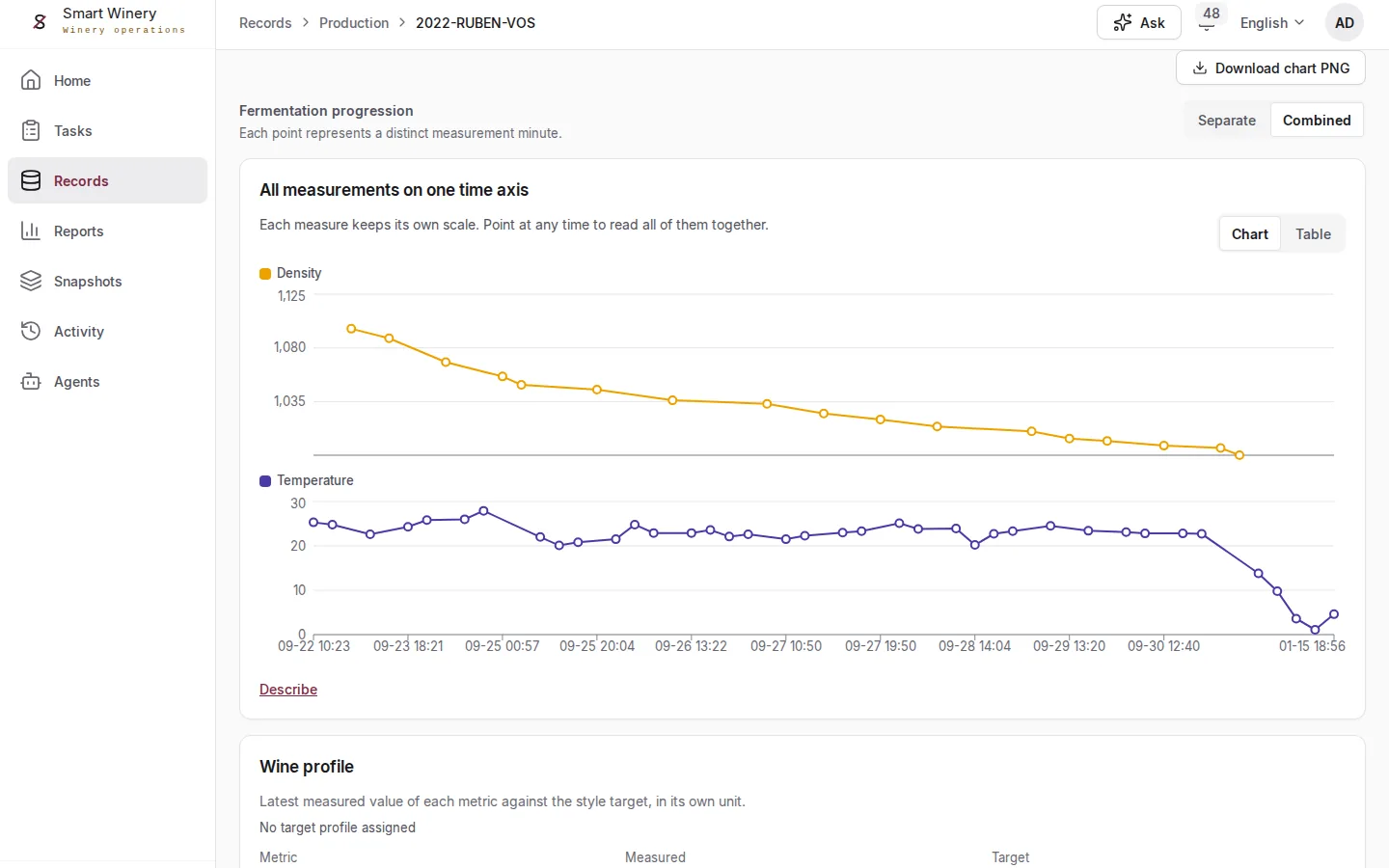
- Readings and charts. Brix, temperature, pH and specific gravity, each on its own chart with the target band for the wine’s style. Readings outside the band are flagged; a stalled fermentation or an overdue reading raises an alert.
- Wine profiles. Target ranges per style, variety and stage, set by the winery.
- Fermentation forecast. The expected end date of each fermentation, with its chart.
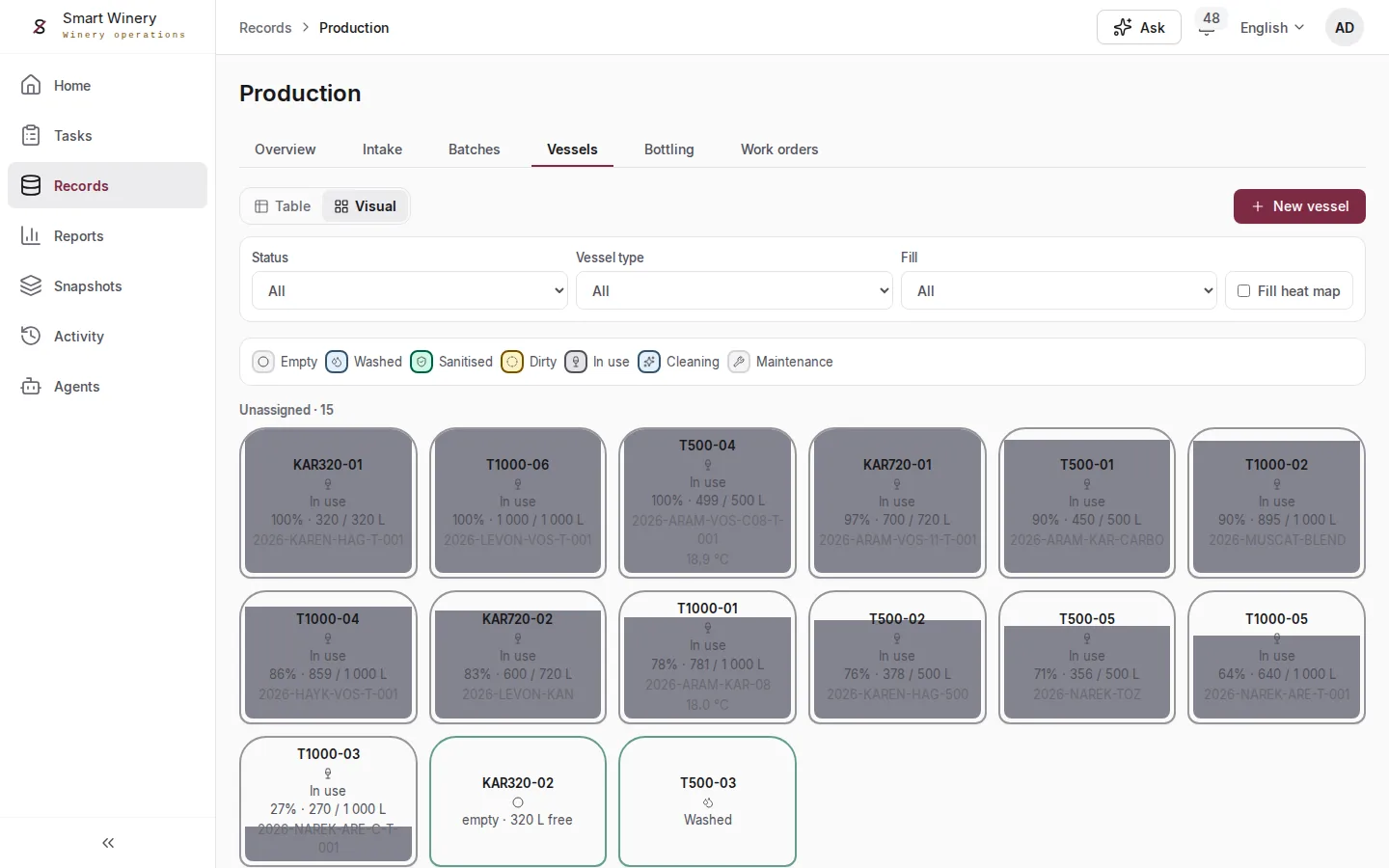
- Vessels. A visual cellar layout by zone with fill levels, status, cleaning log and fill suggestions.
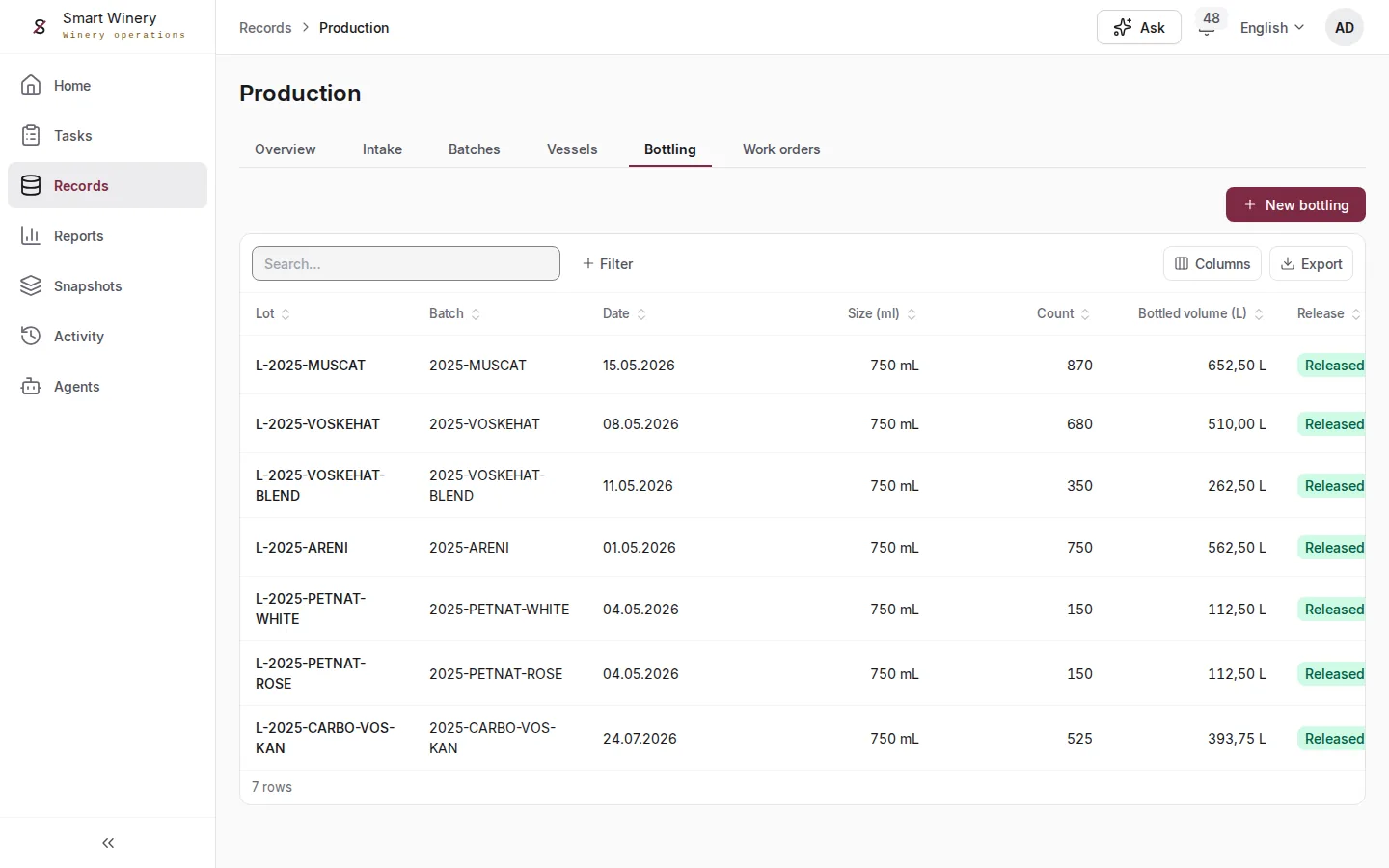
- Bottling. Readiness check, lot preview and packaging use from the bill of materials, then release.
- Work orders. Assigned to cellar staff, started, confirmed with actual quantities. Overdue ones raise an alert.
Inventory Available
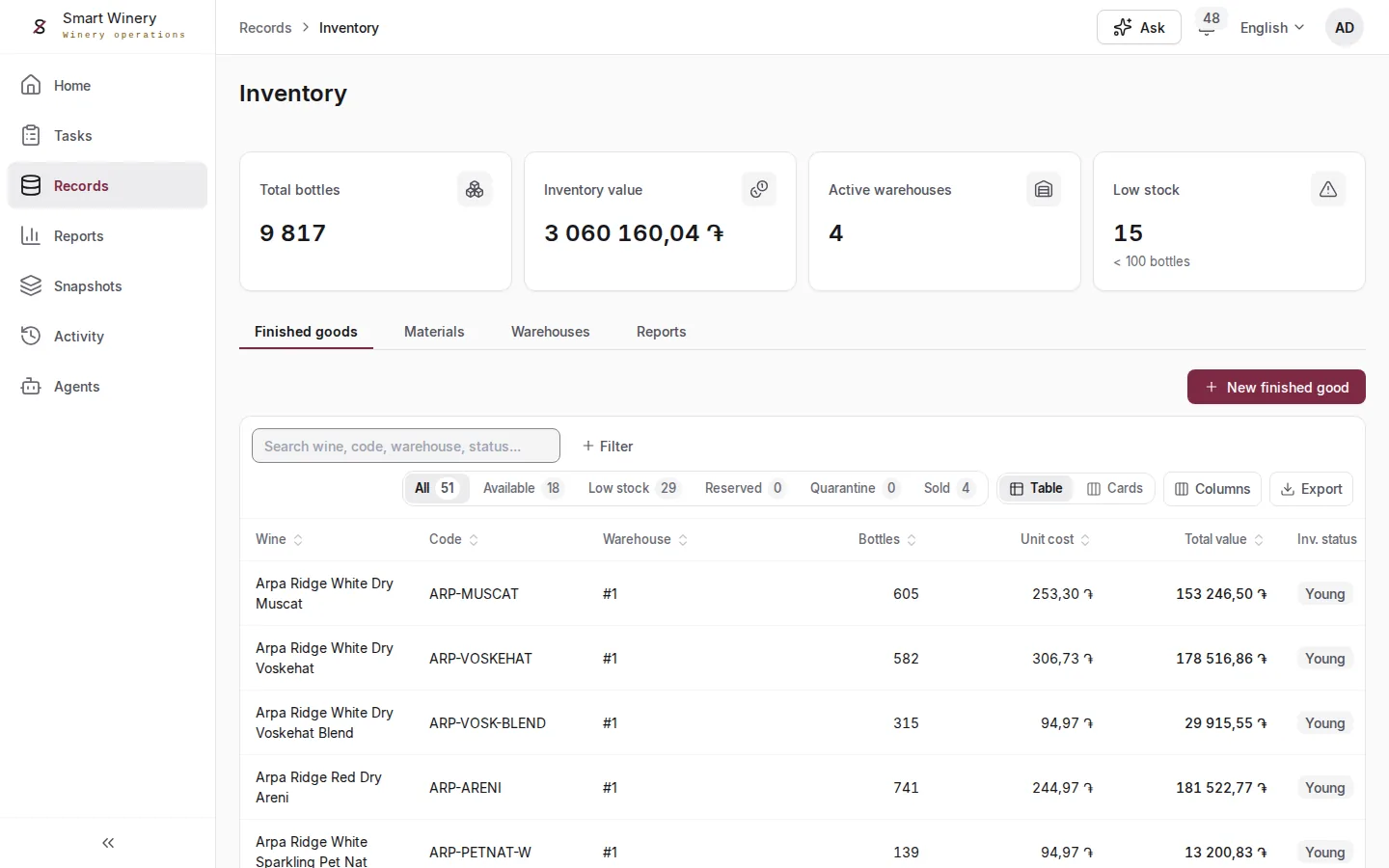
- Finished goods. Bottled wine by product, vintage, bottle size, lot and batch, with unit cost.
- Materials. Corks, bottles, labels and additives in a category tree, kept by lot and expiry, issued first-expiry-first-out.
- Warehouses. Several locations, transfers between them, and consignment stock held at a customer.
- Counts and reports. Stock-count sheets, monthly stock, cellar use and a stock-out forecast. Low, expiring and expired stock raise alerts.
- Bulk wine is tracked by vessel and batch in Production.
- 2027 · S1 Warehouse manager agent. Drafts purchase orders for low stock, proposes transfers and brings supplier invoice lines into stock, for the manager to approve.
Procurement Available
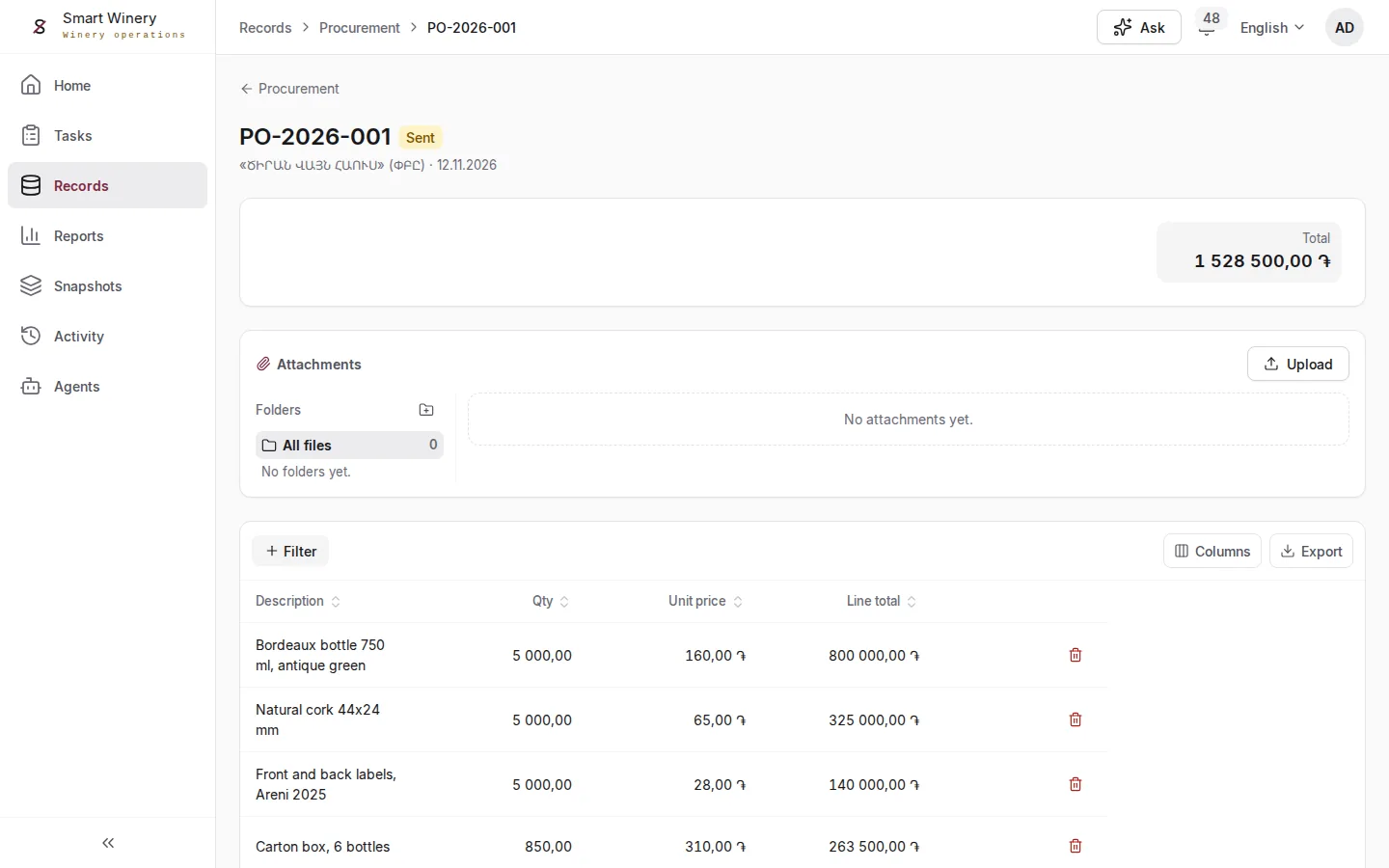
Suppliers, purchase orders with extra charges, and goods receipts that create stock lots when posted.
Documents Basic
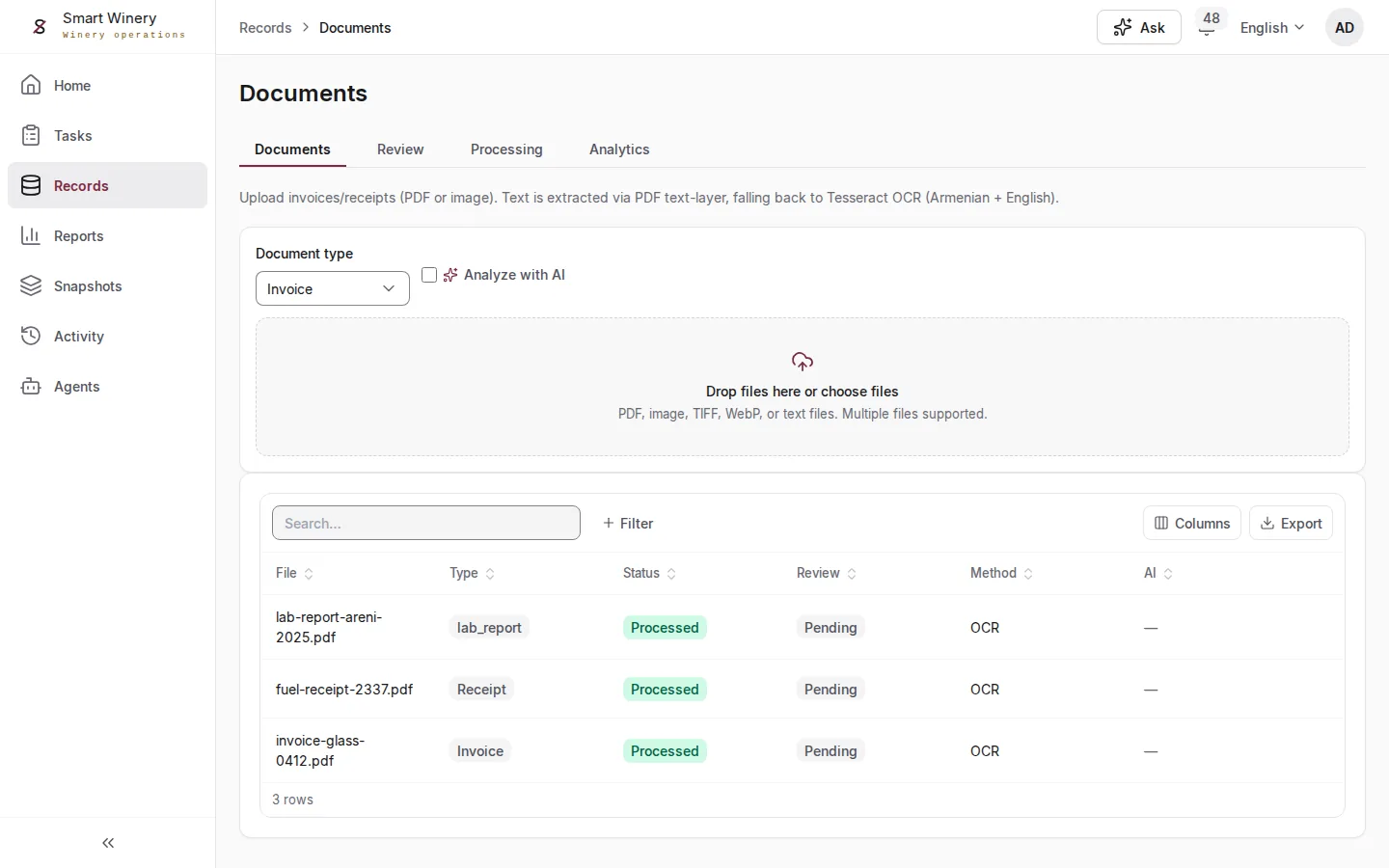
- Today. Upload into folders and link any document to any record. Text is read from the PDF, or by OCR in Armenian and English, and AI extracts the fields, with a review queue and confidence scores. A dedicated reader for Armenian invoices.
- 2027 · S2 Every winery document in the app. Contracts, permits, certificates, invoices and letters in one place: search them by content, draft contracts from templates, and link every document to the vineyard, batch, customer or supplier it belongs to.
Sales and hospitality Available
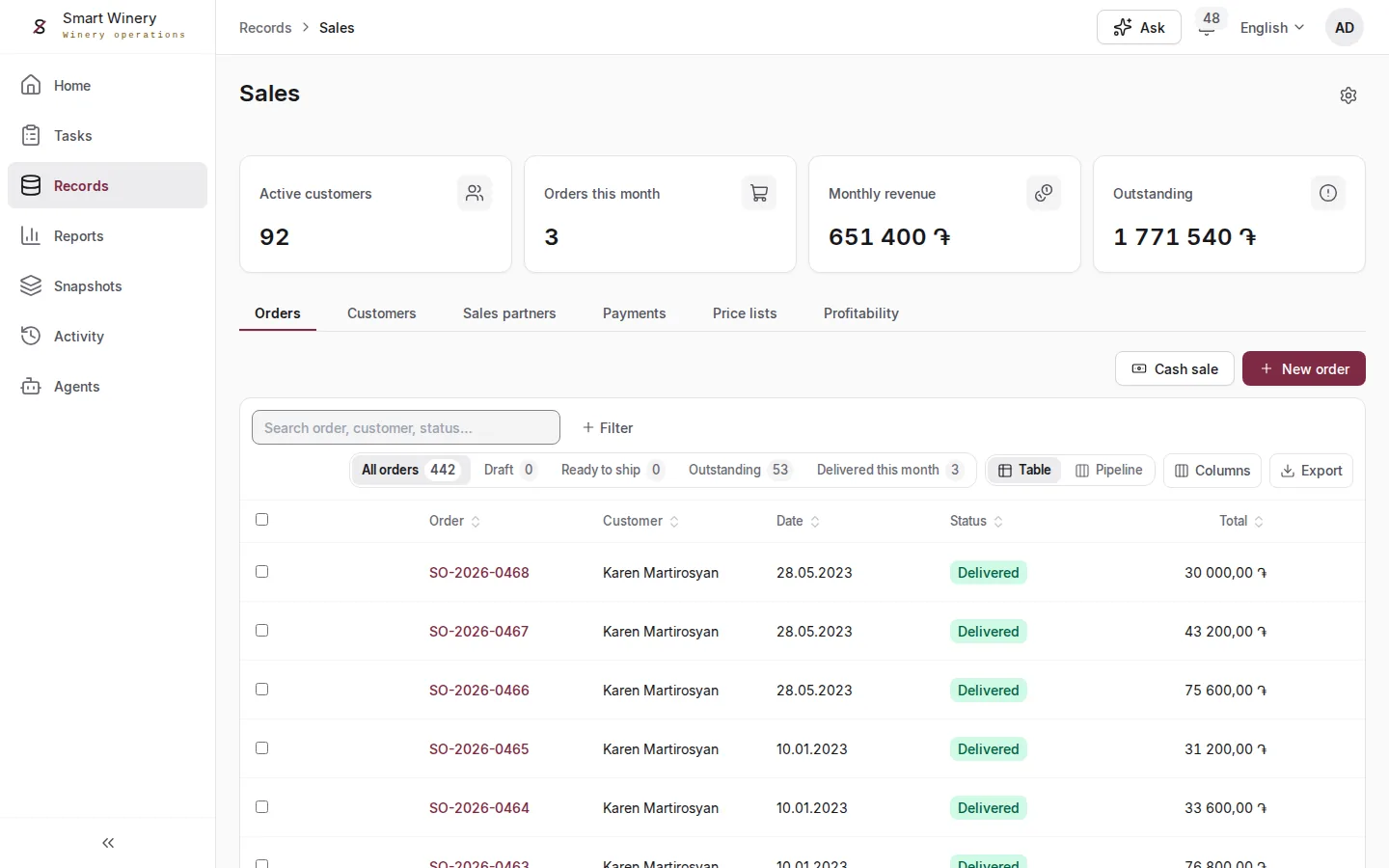
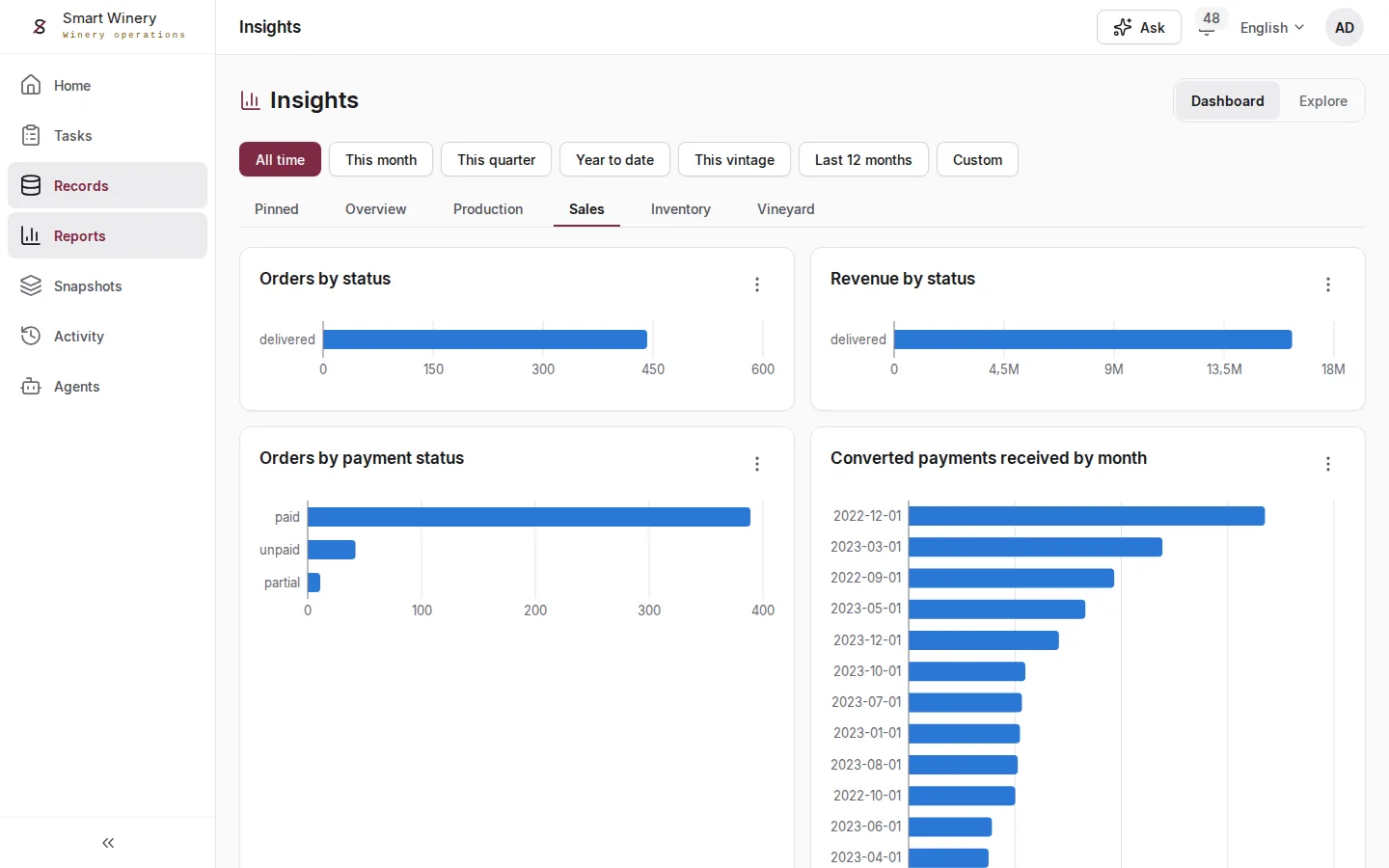
- Orders. From draft to delivered, as a table or a pipeline, with saved views such as ready to ship. Cash sales in one step, complimentary and sample lines with a reason.
- Extra costs. Delivery, marketing and other costs added to an order by rules the winery sets.
- Payments and refunds. Unpaid, partial or paid; refunds per line; every change in the order’s history.
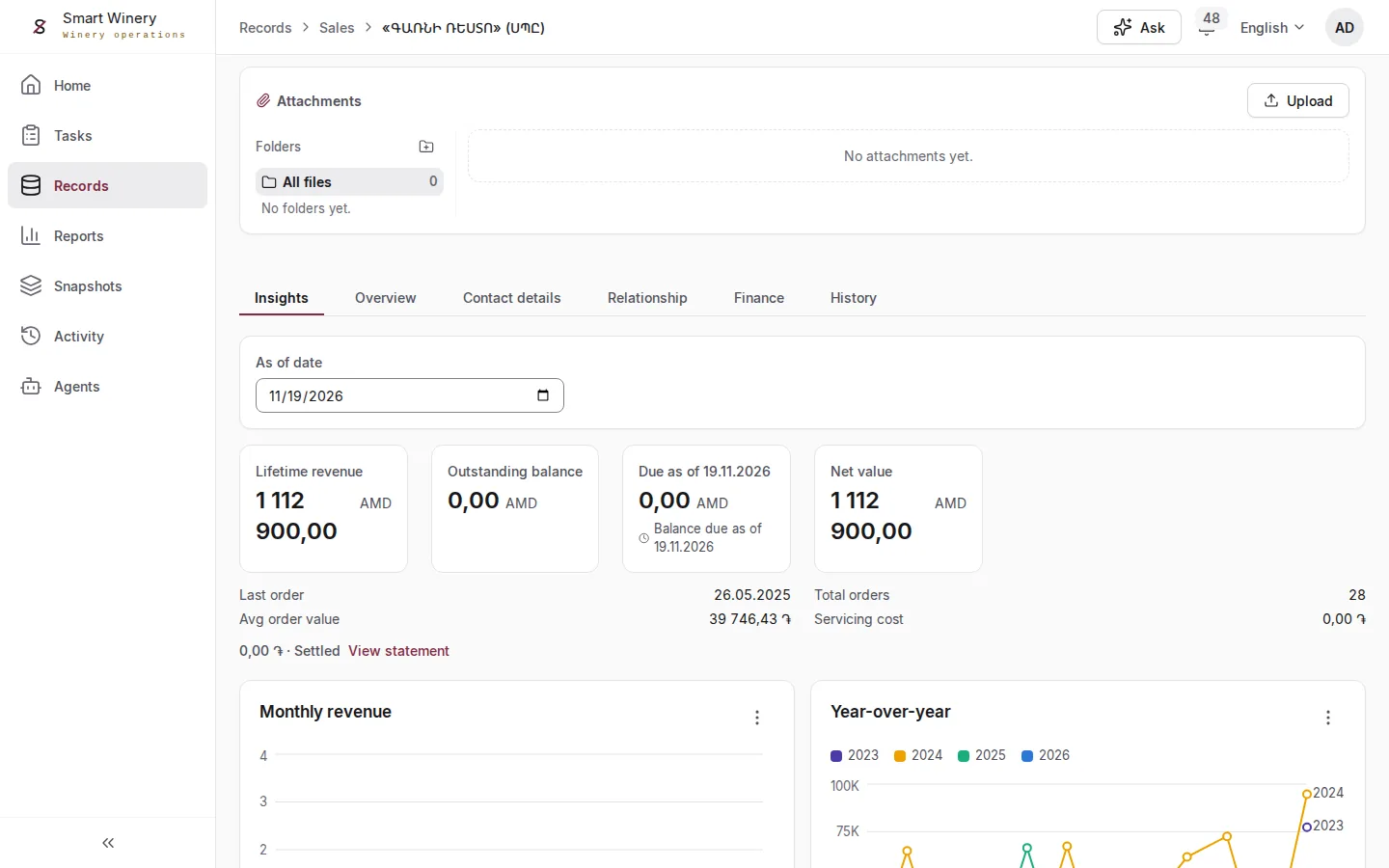
- Customer profiles. Type, channel, partner, sales manager, credit limit, payment terms, addresses and preferences, with planned and logged meetings, revenue, profitability and history.
- Partners. Distributors, agents and resellers, and sales channels.
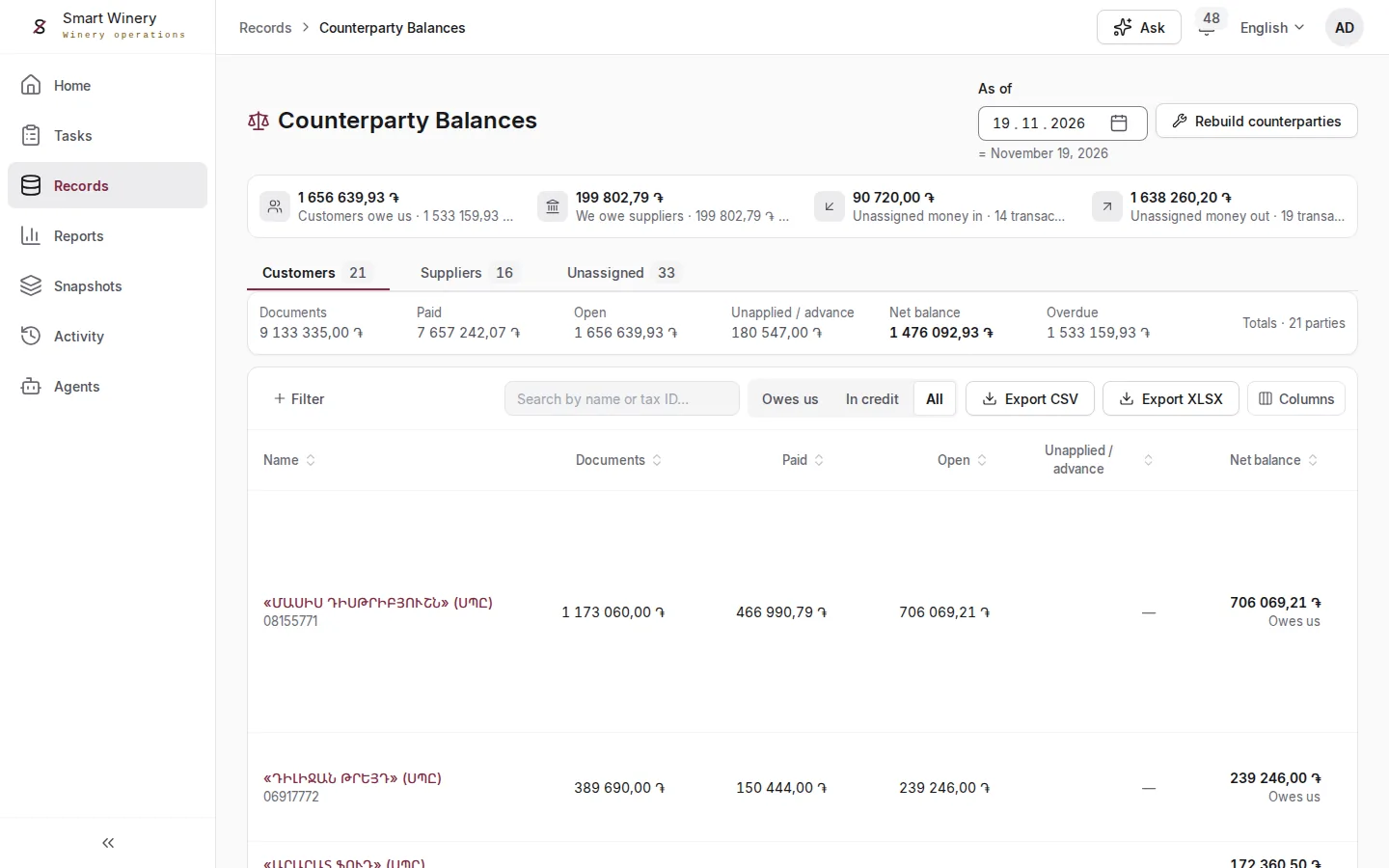
- Balances. What each customer and supplier owes, calculated live from orders, e-invoices, payments and the bank.
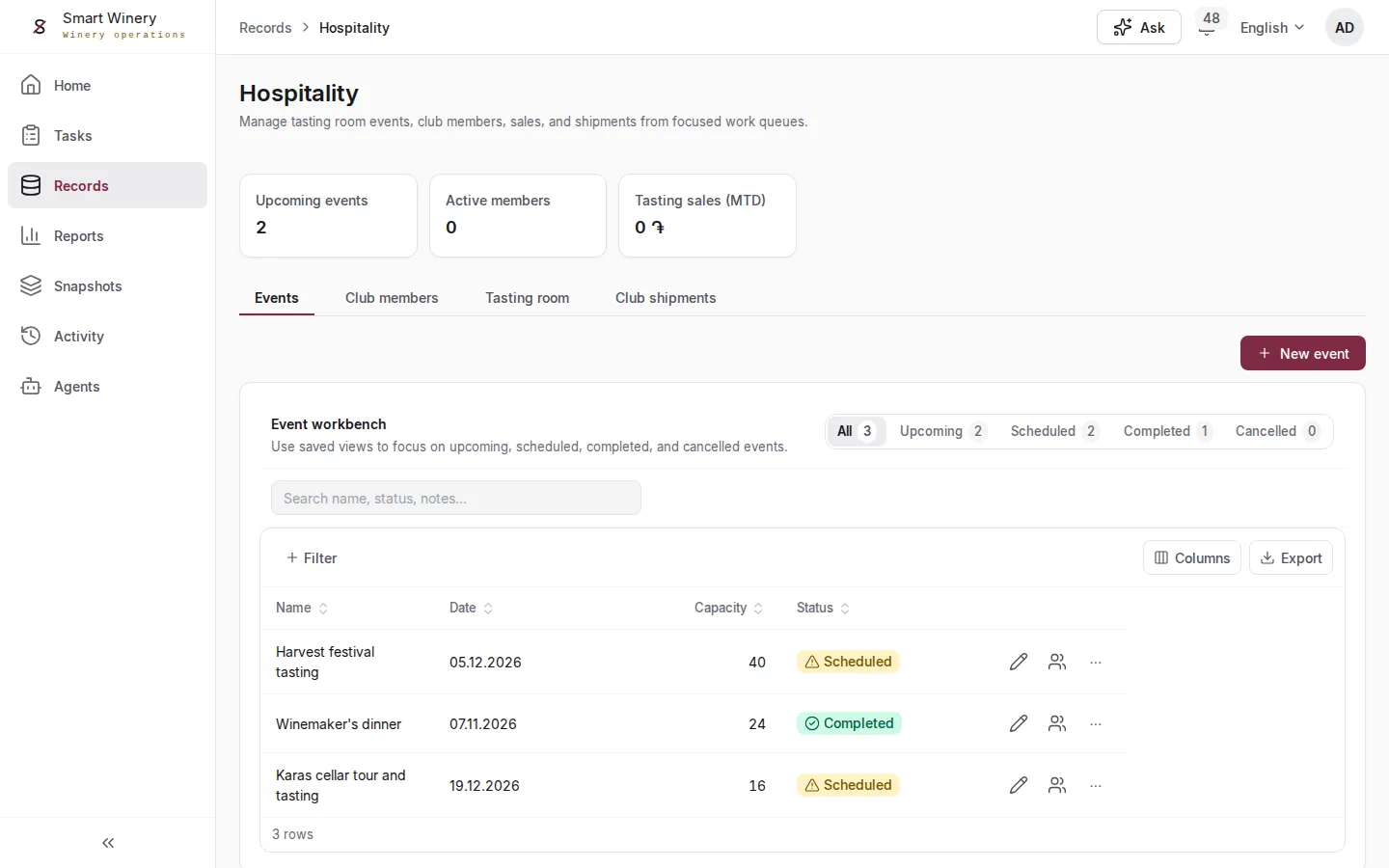
- Hospitality. Events and bookings, and tasting-room sales.
- Sales reports. By month, quarter and year, by manager, partner, channel and product, extra costs, and receivables due.
- 2027 · S1 More sales reporting.
E-invoicing Available
- Import from the tax service. E-invoices exported from the Armenian tax portal (XML, Excel or PDF), issued and received.
- E-mark codes. Per-bottle marking codes imported and checked; excise stamps received, tracked and reconciled.
- Matching. Invoices create or link sales orders, purchase invoices match expenses and orders, and bank lines link to invoices. Product and location names are learned once.
- Discrepancies. Invoice, order, customer and marking codes checked against each other; mismatches are listed for a person to resolve.
- Received goods lines go into stock. Export to Excel, CSV or XML.
- 2027 · S1 Exploring ways to connect directly to the tax service and the e-mark system, so invoices and marking codes no longer need to be exported and imported by hand.
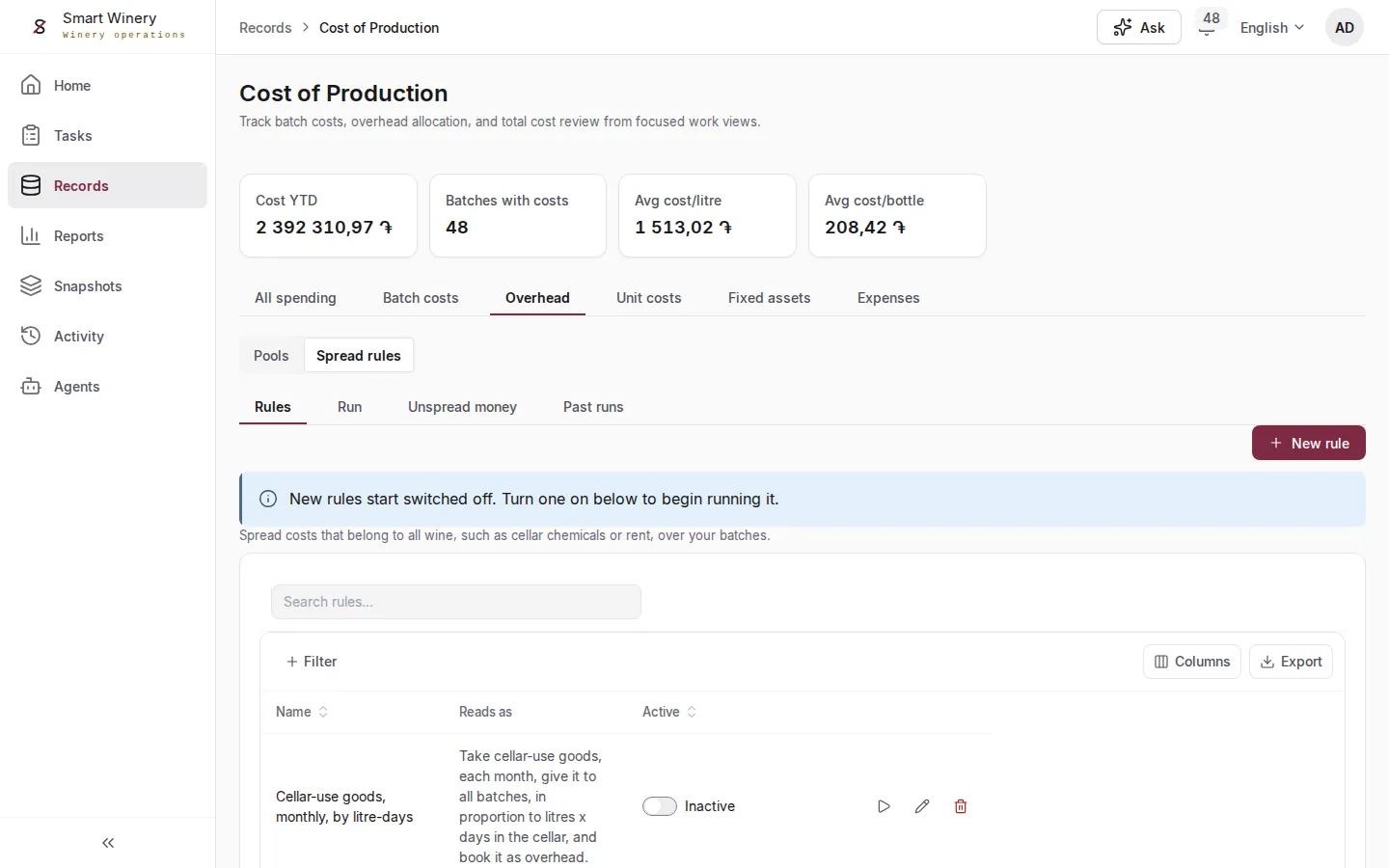
Cost of production Available
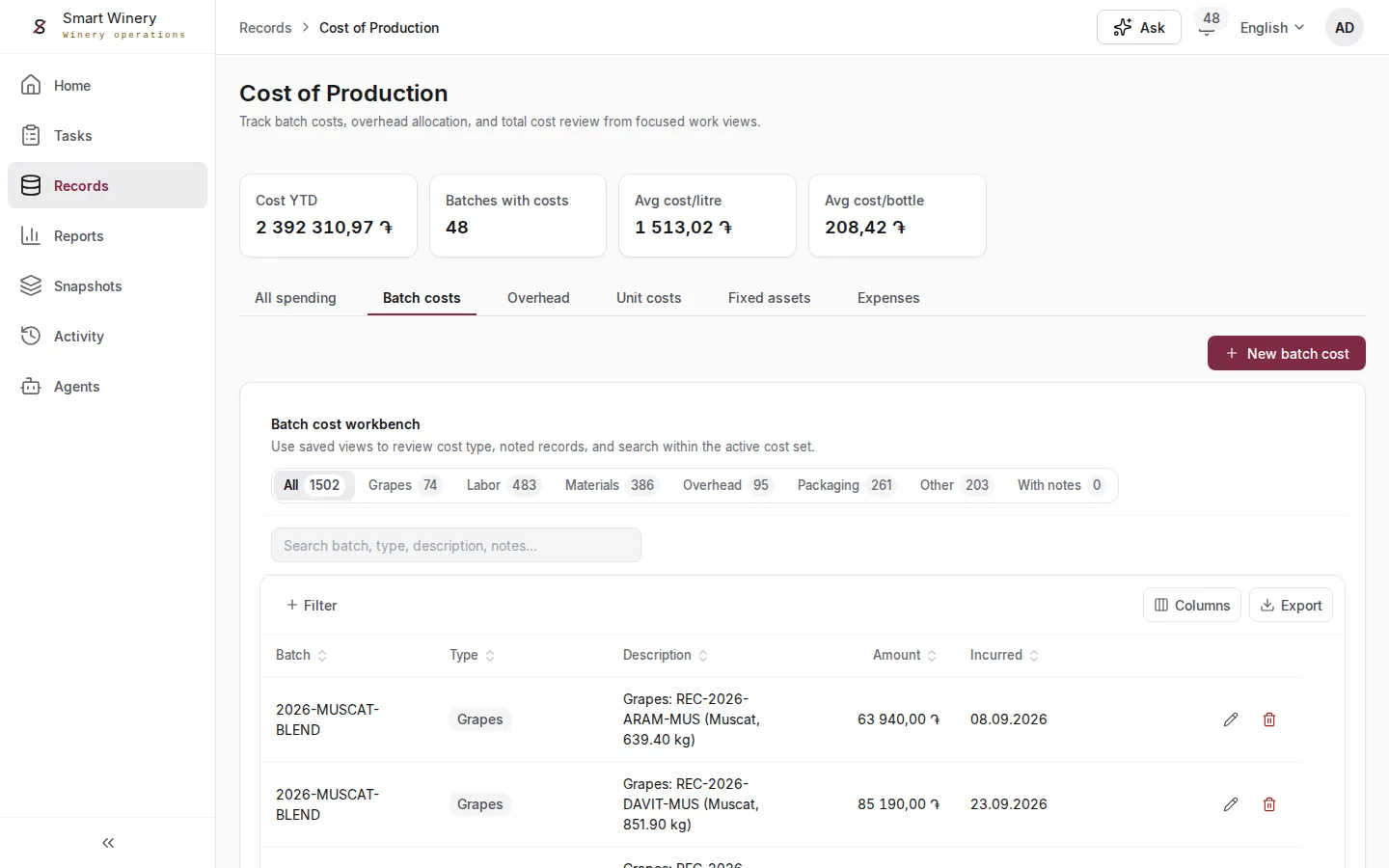
- Direct costs. Expenses with line items, categories, cost centres and payers, allocated to batches.
- Overheads. Power, rent and salaries spread across batches by rules: source, period, which batches and the driver, such as volume. Preview, post, reverse.
- Cost follows the wine. On a transfer, cost moves with the wine.
- Cost per bottle. By cost type, product and vintage. Batch costs can be frozen by a permitted user; reopening needs a reason.
- Fixed assets and leasing. Depreciation runs, leasing schedules and payments.
- 2027 · S1 Cost agent. Proposes cost allocations, flags unusual costs and explains the cost of each wine.
Banking Available
- Accounts and transactions. The winery’s bank accounts and every transaction.
- Statement import. AI reads a statement from any bank into the app’s own structure, with no per-bank setup. A person checks every line before anything is posted.
- Categories. Set by rules and keywords in Armenian bank narratives, by hand or in bulk.
- Matching. Suggested matches to customers, suppliers, payments and e-invoices; a payment can be created from a transaction.
- 2027 · S1 AI for banking. Categorising unknown lines with AI and a cash forecast, on top of today’s suggested matches.
Imports 2027 · S1
Today, bank statements and tax-service exports are imported with a review screen before anything is posted, and tax-service bundles already go through a guided assistant. In 2027 · S1 imports become one assistant: upload anything from the module it belongs to, the assistant classifies each document and asks you to confirm, previews the data, finds discrepancies and invalid rows, and imports only after your final confirmation.
Reports Available
About 50 ready-made reports, and your own built from the same data: cost by vintage, fermentation by tank, harvest intake, stock valuation, sales and receivables, tax summary and more. Group, chart, save and export to CSV, Excel or PDF. Fifteen alert rules feed the home screen.
Administration and modules Available
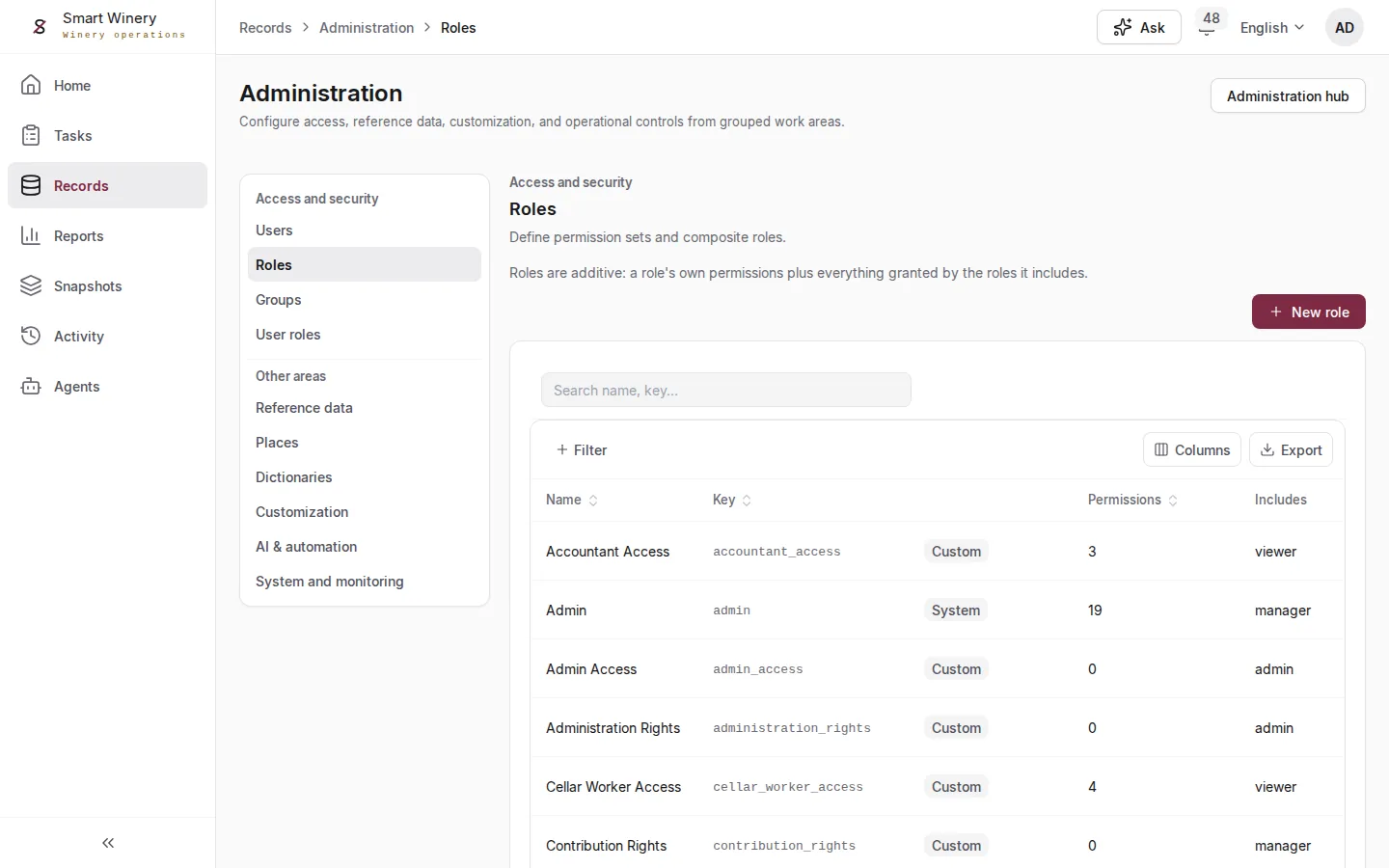
- Roles and permission groups. Read and write rights per module and specific rights such as approving a deviation or releasing wine. Rights are bundled into roles, and roles into groups. Ready-made roles for winemaker, cellar worker, vineyard manager, warehouse manager, sales manager and accountant, all editable.
- Modules. Switch modules on or off; dependencies follow automatically.
- Your own settings. Dictionaries, custom fields, units and currencies, numbering patterns, module defaults, and every label of the interface editable in Armenian, English and Russian.
- History. An audit log of every change.
Upcoming Upcoming
These modules are in the backlog. They are not part of Release 1 and will be described here in detail when they are ready.
- Production planning. Harvest intake plans, tank scenarios, plan against actual, and a vintage plan built from past sales.
- Blending lab. Blend trials on paper with target profiles and tasting notes, then AI blend suggestions.
- Quality control. Lab analyses with ranges and verdicts, certificates, and lab reports read by AI.
- Sustainability. Resource use, chemical applications and certifications.
- Sensors. 2027 · S1 Temperature, humidity, pressure and level devices on a location or vessel, with thresholds, alerts and readings written into the batch.
- Compliance. Checks per export destination, the documents a shipment needs and what a label must carry.
- Wine club. Club members and club shipments, next to today’s events and tasting-room sales.
- Phone app. An app for the cellar, for readings and cellar work with or without a signal. Coming soon.
- Agents. A fermentation forecast for every tank, a warehouse manager, finance questions and tax report drafts, earlier cellar warnings, a natural winemaker helper and a vineyard agent. See the plan.